Unf*ckology by Amy Alkon
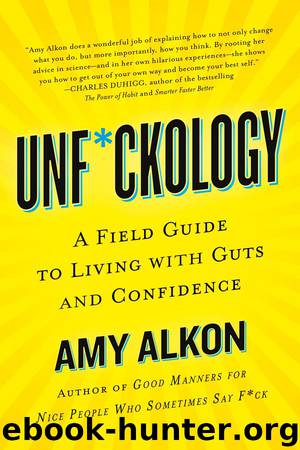
Author:Amy Alkon
Language: eng
Format: epub
Publisher: St. Martin’s Press
BE TRUE TO THE SELF-MADE YOU
Initially, it’ll feel weird and scary to not just do what you’ve probably been doing your whole life—folding up like a possessed lawn chair at the first murmur of disagreement from somebody.
To avoid doing this, it helps to shrink your fears to a more manageable size. A number of “cognitive reappraisal” techniques from chapter 11 are good tools for that. But probably the most helpful for standing up for your new values is this advice, from the late founder of cognitive therapy, Albert Ellis: Consider the worst possible outcome from being true to your beliefs.
Just think about what you’ve seen happen when independent types you know have spoken their mind or done the right thing (and never mind whether anybody else approved).
Worst-case scenario, somebody got a little miffed at them. They may have had a tough week or a tough few weeks. But nothing TERRIBLE! or HORRIBLE! happened. No giant claw crept out from the heating duct and yanked them in, nor did they end up friendless, homeless, and airdropped on a deserted island to be the butt of the joke in New Yorker cartoons.
Sure, disagreement can be uncomfortable—especially when you’re a newbie at it. However, that momentary discomfort is actually a smaller price to pay than the cost of ditching your belief system whenever you’re up against anyone more alpha than a houseplant.
Though we ditch our beliefs like this out of fear, it seems we view this type of self-betrayal—in ourselves and others—as a moral failing. Harvard Business School’s Francesca Gino and her colleagues find that it brings up feelings of “moral contamination” (whoa!) similar to those that accompany dishonesty.
When the Gino team’s research subjects were asked to recall a time they’d gone against their values, they ended up feeling a Lady Macbethian urge to wash (and to use cleansing products like Lysol, Windex, and Crest), along with a longing to engage in morally cleansing acts (do-gooder behaviors like giving to charity).
If this sounds familiar—this need to wash after doing rotten things—it’s a finding echoed by other studies, including a hand-washing study by embodied cognition researchers Spike W. S. Lee and Norbert Schwarz mentioned earlier in the book.
“Building on this research,” Gino and her colleagues write, “we suggest that experiencing inauthenticity results in lower moral self-regard and feelings of impurity, which trigger a desire for physical cleansing and acting prosocially to compensate for violating the true self.”
“The true self”?
I know; you’re probably thinking, “Yo, Alkon, didn’t you just spend most of this chapter telling us there is no such thing?”
And to make matters worse, there’s “inauthenticity” in there, too.
We actually need to cut the Gino team a little slack on that. In using “inauthenticity” and the “true self,” Gino and her fellow researchers are just going with the accepted social science terminology. However, their actual findings—about the negative effects of violating your personal standards—are right on.
It appears that Kernis and Goldman and other “authenticity” researchers were wrong about what they were actually investigating and measuring.
Download
This site does not store any files on its server. We only index and link to content provided by other sites. Please contact the content providers to delete copyright contents if any and email us, we'll remove relevant links or contents immediately.
Still Foolin’ ’Em by Billy Crystal(36470)
Spell It Out by David Crystal(36242)
The Great Music City by Andrea Baker(33662)
Professional Troublemaker by Luvvie Ajayi Jones(29763)
Trainspotting by Irvine Welsh(21986)
Call Me by Your Name by André Aciman(20733)
The Secret History by Donna Tartt(19472)
We're Going to Need More Wine by Gabrielle Union(19172)
Cat's cradle by Kurt Vonnegut(15558)
Ready Player One by Cline Ernest(15146)
Molly's Game by Molly Bloom(14261)
Bombshells: Glamour Girls of a Lifetime by Sullivan Steve(14220)
The Goal (Off-Campus #4) by Elle Kennedy(13965)
Leonardo da Vinci by Walter Isaacson(13519)
4 3 2 1: A Novel by Paul Auster(12623)
The Social Justice Warrior Handbook by Lisa De Pasquale(12294)
The Break by Marian Keyes(9499)
Crazy Rich Asians by Kevin Kwan(9420)
The remains of the day by Kazuo Ishiguro(9225)
